

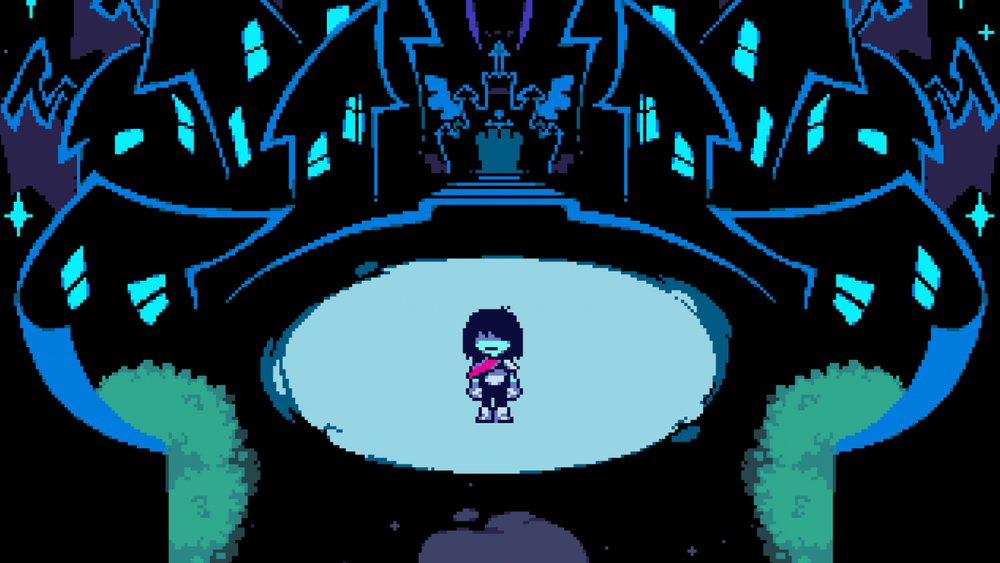
Undertale, Deltarune, And The Choice Of Kindness
Somewhere in a barely explored galaxy, in a vast solar system, on a planet filled with undiscovered creatures in the depths of its seas and riddles and mysteries all over its world, in a room filled with digital toys and miraculous technology, a human asked: „So how exactly are Undertale and Deltarune connected?“
And that human was probably you.
If it‘s not a prequel and not a sequel, what is Deltarune? Much thought has been given to how the games may be connected in-universe, canonically, what happened or is going to happen to the beloved characters, and who exactly Kris even is, but one thing no one seems to talk about is the deepest connection those games may share: The thematic one. It‘s probably a bit of a byproduct of the lack of general analysis and essays of the game as in contrast to the decidedly not-lack of edgy fanworks (a personal guilty pleasure I must admit), so the focus of the fans has mostly been in what-ifs, alternate designs and skeleton puns and not…well, what Undertale even was about in the first place.
In come Deltarune, a not-sequel-not-prequel, repeating the same cycle, but this time with an extra dose of fluffy boys, a whole lot of anagrams and everyone‘s new favourite mean horse. And it certainly gets confusing when you reunite with Undertale characters, but something about them is different, so it‘s no surprise that the „How does this setting relate to the setting in Undertale?“ ended up being the main question, next to „What the fuck was with that ending?“ and „Can I adopt Ralsei and make him hot cocoa?“ The consensus of „Play Undertale first, then Deltarune“ is usually based on the much, much improved gameplay in Deltarune, but that‘s why I‘m here: To make a new point.
Deltarune is not a sequel, or a prequel, it‘s a successor – a thematic sequel that after Undertale, wasn‘t just fitting, but even necessary, to illuminate both sides of the metaphorical coin of theme perpetually flipping in the hyperspace of thematic agency and what it means to be kind in a world that lets you make that choice…or doesn‘t. Ladies, Gentlemen, and skeletons, this is:
Undertale, Deltarune, And The Choice Of Kindness

Deltarune and Undertale are different sides of one coin: The choice to be kind. What does it mean to have a choice to be kind? What does it mean when you have no choice?
Undertale explores the idea of being kind even when it‘s more difficult than being unkind to more or less its fullest. If you are kind to monsters, they return kindness to you. If you show love to the hateful, they can learn to love as well. If you meet the world with cruelty, you will be hit with the consequences eventually. And often, the same will go for reality: Kindness breeds kindness.
By the time you play Deltarune, you have an idea of the type of morals that are in play in these games, so most players adhere to the moral code Undertale demonstrated in the true pacifist playthrough. In fact, you‘re made to adhere to the moral code, you don‘t even get to figure out your morals for yourself. And then…
They fail.
And again, the same often goes for reality. You never want to hurt someone‘s feelings, but sometimes you have to. You never want to be unkind, but sometimes you need to. You want to change people‘s minds and redeem them but in the end, your words fall on deaf ears.
Reality is cruel, and reality doesn‘t always give you the choice.
I do not (yet) know how Undertale and Deltarune are connected in-universe or how the new versions of the characters are connected to the old ones, but I think this isn‘t really the central question here. The games aren‘t connected by story, but what they are about, and how they complete each other philosophically. It‘s the choices you have or don‘t have, what kindness can or cannot do.
Because kindness is powerful.
But eventually, we are hit by the sobering realization, that even kindness has its limits.

Undertale is a game that gives you the choice.
At a base level, that‘s the concept in Undertale, „The friendly RPG where nobody has to die.“ You go through its world and make small choices. Do you kill the Froggit, or do you let it live? Do you attack Whimsun, or do you spare it? Do you tell Papyrus you ate his spaghetti, or do you tell him the truth and risk hurting his feelings? It‘s these small choices that are immediately inconsequential (unless you‘re aiming for a specific ending) but amount to a choice-cluster and counters that eventually give you a conclusion reflecting how many times you‘ve chosen to show kindness and/or mercy, and how many times you didn‘t.
Morality systems tend to fail in games, but Undertale doesn‘t exactly have one. It keeps track of how many times you kill, and in certain instances how you treat others, but in the end, the evaluation is up to you. If you‘re not kind to some of the characters after what they‘ve done to you, the game won‘t judge you. There‘s no real solution when given the choice between pretending anime is real so you won‘t hurt someone‘s feelings, or telling them the truth because you value honesty. And that allows you to really make the choice on your own.
What matters here is that all those choices matter. Maybe not from a gameplay perspective in some cases (like what you respond in a dialogue or whether you try to flirt with Toriel or not), but the interaction with the characters alone, how they react, and how you‘ve made them feel is already considered a consequence in itself. The game really likes to drive this point home, some consequences sticking with you even after resetting the game. Your actions have consequences. It‘s a double edged sword: You have agency, but you‘re also responsible for everything that happens.
Now, what‘s the first thing that happens in Deltarune?
As expected from Toby Fox, the game starts with a subversive joke: You‘re presented with a character creator, dress up a protagonist with different hairstyles and sweaters, only for your version to be rejected because in this world, we can‘t choose who we are, fuck you, here‘s Kris.
In hindsight, it‘s a perfect summary to the themes of the game.
Deltarune sets you up to expect another Undertale pacifist-style game, only to pull away the ground under your feet. You go in playing as if you were playing Undertale on a true pacifist playthrough, lead by Ralsei, you befriend monsters that are initially mean, and so it goes on, but then something changes.
In Deltarune, for the first time, you hit the limits of mercy. You meet someone that no matter what, you cannot redeem, and you cannot befriend.
And that‘s what the game has been really telling you this from the start: In Deltarune, you don‘t get to choose. You don‘t get to choose who you are – you are Kris, you don‘t choose how you confront monsters – Ralsei chooses for you, and you don‘t get to choose how it ends – there is only one ending in this game.
Your soul is caged.
Your choices don‘t matter.